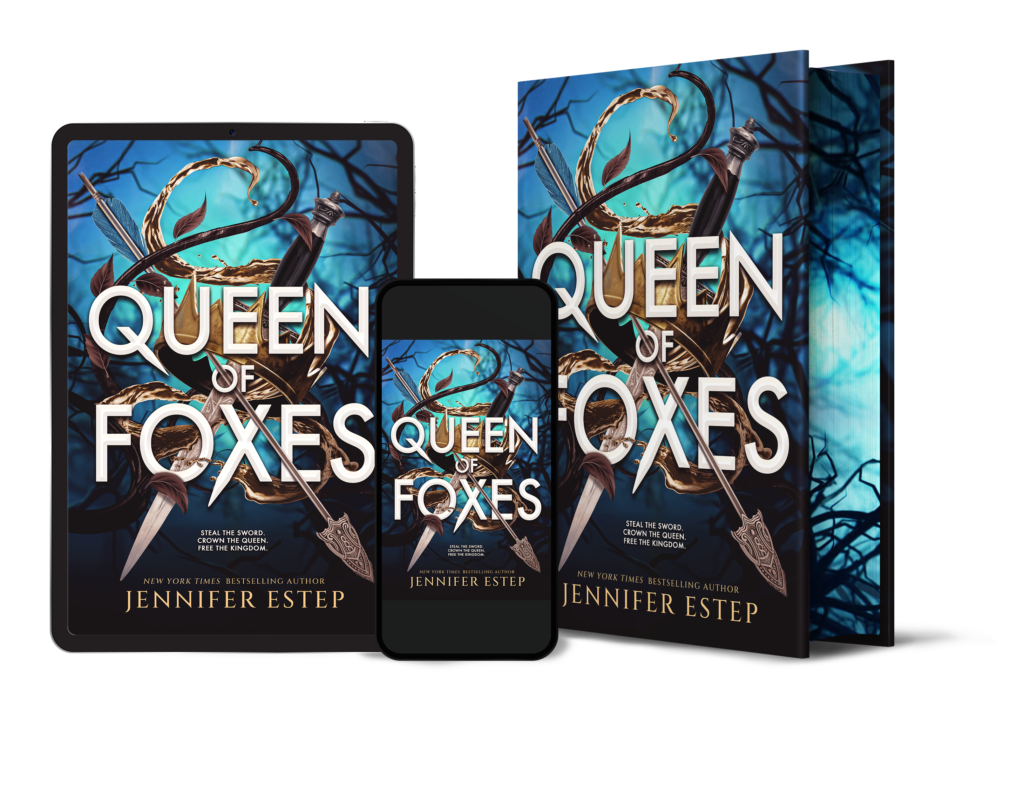
Thanks to my publisher, I have one (1) print ARC to giveaway for Queen of Foxes, book #1 in my Robin Hood-inspired romantasy series that comes out Dec. 1. Woot!
To enter, fill out the form below. Due to shipping costs, the giveaway is open to those 18 and older, U.S. addresses only. No purchase necessary. Void where prohibited. The giveaway runs through Oct. 31. Thanks for reading! ❤️
Bad news:Queen of Foxes has been pushed back to Dec. 1. The special edition hardcover, ebook, and audiobook will all be released on Dec. 1 now.
Good news: It’s only a three-week delay and the book will still be out before Christmas.
Bookstore campaign: The indie bookstore pre-order campaign is still taking place. You can see all the current participating stores on the pre-order page.
Why the delay? Because of supply-chain issues, tariffs, fuel costs, and other printing issues. Here’s an article with more info. I think it’s behind a paywall, but the first paragraph is a good summary.
I’m so sorry about the delay, but it’s one of those things that I have zero control over. Y’all, sometimes, I think I’m cursed. Something bad/wacky/unexpected like this ALWAYS happens to my books. 😅 Seriously, you wouldn’t believe some of the horror stories I have accumulated over the years.
Anyway, I’m still so excited for y’all to meet Rinley and Zoren in a few (more) weeks. If you have any questions, put ’em in the comments below. Thanks for your patience and thanks for reading! ❤❤❤
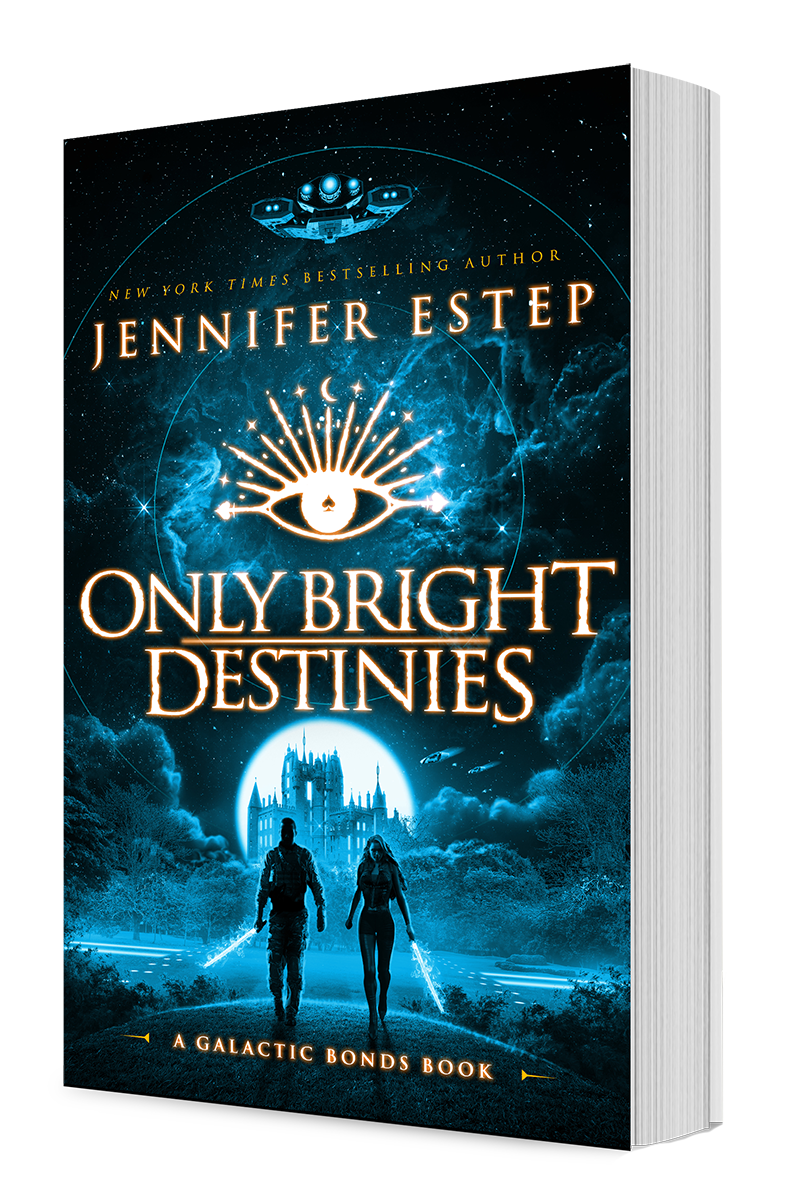
Only Bright Destinies is a full-length book about Vesper Quill and Kyrion Caldaren (about 127,000 words). It will wrap up some of the major storylines, although I am planning to write more books in my Galactic Bonds series about another couple. #IYKYK 😉
Lauren Fortgang and James Fouhey will once again be the voices of Vesper Quill and Kyrion Caldaren. I’ve gotten so many nice comments about their narration, and I’m so glad they are back for the latest book. 😁
Only Bright Destinies is book #6 in my Galactic Bonds science-fiction fantasy series. It will be released in ebook, audio, and print book (paperback and hardcover) on Feb. 16. Thanks for reading! ❤
Only Bright Destinies tropes and Description:
Love Star Wars-type stories? This is the book/series for you! Tropes include:
Science-fiction fantasy ⚔️
Fated mates ❤️
Space opera ✨
Fated mates ❤️
Pew! Pew! Pew! action scenes ⚔️
Heroine and hero’s first-person POVs ✨
A touch of historical romance ❤️
“This is space opera at its finest.”—Ilona Andrews, #1 New York Times bestselling author on Only Bad Options
New York Times bestselling author Jennifer Estep continues her Galactic Bonds science-fiction fantasy series with a rollicking new adventure that blends science fiction and fantasy with a dash of historical romance. The action-packed space opera features a mix of magic and technology, along with a soulmates story and “Pew! Pew! Pew!” battle scenes. Perfect for fans of Star Wars, Dune, and Bridgerton.
A WOMAN WHO CAN’T SEE HER ENEMIES’ PLANS . . .
My name is Vesper Quill, and I’m good at figuring things out. Over the years, I’ve used my skills as an inventor and an engineer, along with my seer magic, to solve one hard problem after another.
My current mission? Discover where the members of the Techwave terrorist organization are hiding and what deadly weapons they plan to unleash on the Archipelago Galaxy.
With the help of Kyrion Caldaren, my truebond partner, I follow a series of clues to a distant planet. But the Techwave’s plot is much bigger and far more horrific than I ever imagined, and even the enormous power of our truebond might not be enough to help Kyrion and me save the galaxy.
A MAN WHO IS RUNNING OUT OF TIME . . .
My name is Kyrion Caldaren, and I excel at killing my enemies. As an Arrow, I spent years honing and using my telekinesis, telepathy, telempathy, and other psionic abilities to defend the people of the Imperium.
My current mission? Protecting Vesper from Callus Holloway, the greedy siphon who wants to tap into the power of our truebond connection. Too bad I have no idea how to kill Holloway or stop him from taking our magic.
When Holloway and our other enemies put us in a desperate situation with only bad options, I vow in the coldest depths of my heart to give Vesper the bright destiny she deserves—even if I have to sacrifice myself.
Readers who pre-order through these indie bookstores will receive the Queen of Foxes special edition hardcover book, a bookmark, a signed book plate, and an enamel acorn pin. How cool is that?!😎
Queen of Foxes will be released Dec. 1, so please pre-order ASAP.
Several folks have asked me to share an excerpt from Queen of Foxes. Here you go! Below is the opening scene from Chapter One. To read the full chapter, visit the QOF book page on my website, scroll down, and click where it says “Read an excerpt from Queen of Foxes”. Thanks for reading! 💘
CHAPTER ONE
RINLEY
Most things were surprisingly easy to steal.
A skim of fingers removed a diamond cuff from a lady’s wrist. A gentle tug netted the gold watch on a lord’s vest. A hard bump into a guard’s side procured the keys on his belt.
Oh, yes. Most things were simple to swipe. It’s the ones that weren’t so easily obtained that I couldn’t resist stealing—like the item I was after tonight.
A raindrop slipped past the dark-green hood that covered my head and tapped the end of my nose like a playful finger. I pulled the long cloak a little tighter around my body. The night was cold and miserable, with a steady rain that showed no signs of stopping. The damp chill kept people inside instead of wandering the street below.
Fewer potential witnesses was always better for a thief like me.
I’d been ensconced on the roof for the better part of an hour, hiding in the shadows cast by a gargoyle statue perched on the corner. Two floors below, music and laughter trilled through the air, while warm, soft light spilled through the windows and arced into the darkness.
For the last week, I’d been working as a maid for Lady Fran, a demanding noble who had hired extra staff in preparation for her birthday soiree. Dusting, sweeping, and mopping weren’t my favorite tasks, but playing the part of a meek, quiet maid let me access the lady’s townhouse and smuggle all the necessary supplies onto the roof for my impending heist.
A fresh wave of music and laughter erupted. Impatient, I rubbed my thumb over the silver fox-face ring on my left index finger. Two small, diamond-shaped emeralds glittered as the fox’s eyes, while tiny acorns, vines, leaves, and thorns were etched into the silver band that formed the creature’s body and tail. The ring had belonged to my mother, Bellandra, a royal seamstress, and the fox was a crest of the Renards, her noble family that had fallen into disgrace and poverty a few generations ago.
Another raindrop tapped my nose. I sighed, wiped the wetness off my face, and peered through the drizzle at the opposite side of the street.
The Bemalen Museum took up its own block in Antiquas, the capital city of the kingdom of Tychen. Fat, stubby towers made the building look like a misshapen mushroom squatting in the shadow of Lady Fran’s slim, elegant abode. A few lights burned in the museum’s windows, but most of the structure was dark.
Two guards manned a ten-foot fence with a central wrought iron gate that served as the museum’s main entrance. Their chins were tucked down into their gray uniforms to escape the chilly rain, their breaths steaming out in wispy clouds.
In the distance, a bell tolled the midnight hour.
Finally.
Time to work.
I crouched, scooping up a bow and quiver of arrows. They weren’t made of the strong sherwood I preferred, but they would get the job done. Just about anything would, if you were determined enough.
Determination was the one thing I’d never had to steal from someone else.
As the last echoes of the bell faded away, the guards turned to face the sturdy gate, while two of their comrades in dry cloaks emerged from the museum. The shift change was right on schedule. Excellent. Prompt people always made my job so much easier.
The dry guards ambled toward the gate while the wet ones impatiently stamped their feet. While they were distracted, I nocked an arrow, lifted the bow, drew back the string, and sighted down the length of the shaft at my target—a lion statue on the corner of a museum balcony.
Inhale.
Exhale.
Release.
The thwang of the bowstring reverberated through my fingers and spread through the rest of my body like an old, welcome song. The arrow streaked through the air, trailing a length of thin black wire behind it. The arrow punched deep into the lion’s chest, making a few chips of stone fly out of the statue.
Bull’s-eye.
One of the dry guards stopped and spun around. “Hey!” His voice drifted across the street. “Did you hear that?”
I held my breath. The rain hadn’t muffled the sound of the chips hitting the cobblestones below as much as I’d hoped. Drat.
All four guards looked around, their heads snapping back and forth, their hands gripping the swords belted to their waists.
“The only thing I hear is you,” one of the wet guards complained. “Now hurry up and let us in so we can dry off.”
The dry guard harrumphed, but he and the other man moved forward.
I slung the bow and quiver onto my back, then tugged on the end of the black wire I’d knotted around one of the gargoyle’s curved horns. Satisfied it was secure, I donned a pair of gloves, hooked my belt to a sturdy leather strap, and attached the other end of the strap to the wire.
I eased over to the edge of the roof and peered down at the street ten stories below. Warm, heady excitement rushed through me, driving away the damp chill. In the circus where I worked when I was younger, the high-wire, trapeze, and other stunt artists had called this the moment of no return, when they would either walk or fly through the air—or fall to their deaths on the ground.
Inhale.
Exhale.
I stepped off the roof.
The metal hook slid down the wire with a quiet whisper, taking me along with it. Wind whipped the hood off my head and tangled my black hair, while rain spattered against my cheeks and soaked into my dark-green tunic and black pants.
I swallowed a happy laugh and looked down, watching the guards again. All four men clustered around the gate, which featured four locks with four different keys that had to be turned all at once. The guards were so focused on synchronizing their movements that they didn’t see me sail right over their heads. Museum officials trusted guards and gates to keep thieves at bay, so they didn’t bother to protect the open air overhead.
Their mistake was about to be my gain.
The museum rushed closer and closer. I could still be smushed against the wall like a bug on a glass pane, so I gripped the wire tightly through my thick gloves to slow my rapid approach.
Five…four…three…two…one…
I lifted my legs so my feet touched the wall first, the soles of my black boots scraping against the stone. I quickly bent my knees and tensed my muscles to keep from pitching forward and slamming my nose against the dark-gray granite. I hung there for several seconds, absorbing the jarring impact, then lifted my legs a little higher and maneuvered my body up and over the low wall that cordoned off the balcony.
I unhooked myself from the wire and dropped down into the shadows beside the lion statue. The glass doors that opened onto this level remained closed, no lights blooming behind them. No one had seen me slide into position. Good.
I exhaled, got to my feet, and peered over the balcony wall. Down below, the guards had turned all their keys and changed positions. Once the wet guards entered the museum and the dry ones faced the street, I pulled a glass vial from a pouch hanging off my belt.
I popped out the stopper and sprinkled the pale, red-orange powder—crystalized luxoil—onto the arrow still stuck in the lion statue. The powder ignited with a hiss of white smoke and started climbing the wire. In the circus, we often used the powder to create magical effects, but thanks to the extra oomph in this concoction, the arrow and the entire length of wire started burning.
I peered over the balcony at the guards. A few bits of ash fluttered down and landed on the left shoulder of one of the men. I tensed. If he grew suspicious and looked up, I would have to run for my life the way I had so many times before.
The guard coughed and waved away a wisp of smoke. “Bloody fog. I hate the damp creeping into my lungs.”
The other man muttered his agreement.
I exhaled with relief, then slid the empty vial into my pouch and headed for the nearest door. Locked, of course, but that was no problem. I placed my index finger against the oak frame, then drew a quick semicircle around the lock. The wood quivered in response, and the lock flipped.
I grinned, opened the door, and slipped inside the museum. The luxoil lights in the brass wall sconces had been turned down low for the night, and the dancing flames cast faint orange glows onto the paintings that adorned the walls. Slender black marble pedestals topped with pretty porcelain vases and crystal statues jutted up here and there like flowers sprouting in a nighttime garden.
It didn’t take long to creep down the steps to the third floor, which was filled with long, tall shelves housing relics imbued with a variety of magical properties. Relics could be any shape, size, or object, though most were fashioned into everyday items—rings and bracelets, daggers and books, cups and combs. I moved past those and a dozen other objects before stopping in front of a simple but elegant silver hairpin studded with sparkling white crystals.
“Hello, gorgeous,” I whispered.
The hairpin’s magic made a person look ten years younger. Not particularly powerful compared to other relics, which could shoot out blinding rainbow prisms or emit clouds of smoke that would put folks to sleep for days. But even the smallest, simplest relic could be useful and valuable.
A museum worker had found the pin two years prior at an open-air market and given it to her sister as a gift. After the worker’s death a few weeks ago, museum officials had claimed ownership of the relic and confiscated it from the grieving sister. Looting the possessions of regular folks was a despicable but common practice at some institutions.
I hated bullies above all else.
When I’d heard the story from my employer, I’d decided to do something about it. What was the point of being a master thief if I couldn’t right a few wrongs every now and then? Steal from the rich, give to the poor was just about the only code I had.
Besides, the Bemalen Museum officials lauded the fact their facility had never been breached, much less robbed. I loved a challenge, particularly when it gave me the chance to pop a bubble of puffed-up pride.
I plucked an ordinary pin out of my own hair and used it to jimmy open the lock on the thick glass sheet protecting the shelves. A few seconds later, the glass was out of the way, and the sparkling relic was tucked into one of my pouches.
From my pocket, I withdrew a small acorn with an emerald-green cap resting atop a glossy ebony nut. A pang of longing shot through me. Sherwood trees were native to Feronia, my home kingdom, and it had taken me three days to find one in a botanical garden in Antiquas.
I placed the acorn on the gray velvet pillow where the hairpin had been. Like many thieves, I had a name and reputation to uphold. Leaving a sherwood acorn behind at the scene of my crimes was my calling card—a way to take credit for the seemingly impossible heist.
The Green Fox had struck again.
Get Connected!
Sign up for Jennifer’s newsletter to get the latest information on her books, as well as cute cat photos and book recommendations.
Thank you! You have successfully subscribed to our newsletter. Please check your email and click on the confirmation link.