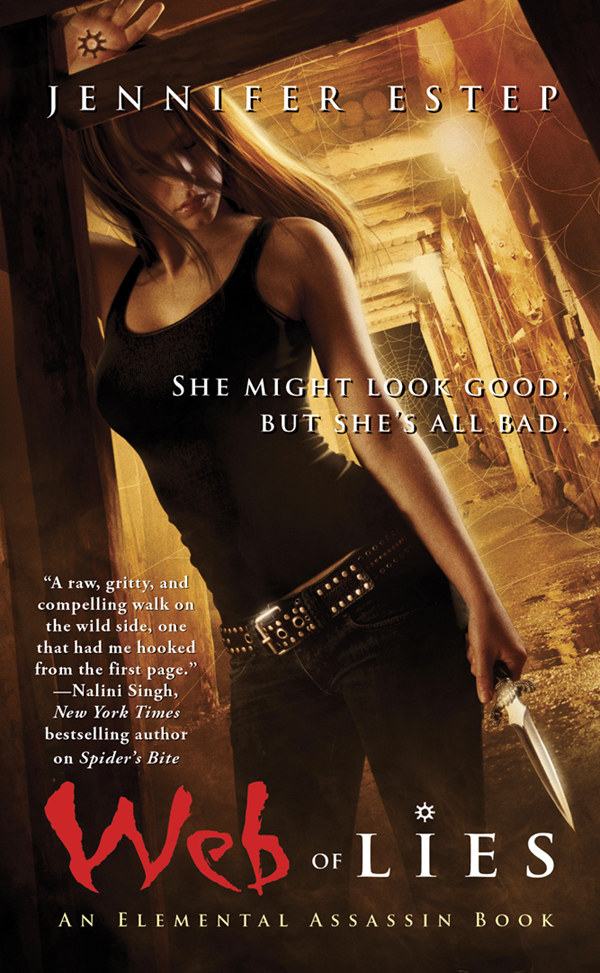
Everyone always asks me how much money I make on my books. In fact, it is a favorite question with certain nosy relatives of mine. Contrary to popular belief, it is not millions and millions of dollars. (I know. I’m bummed about that too). So today, I thought that I would talk a little bit about royalties to try to answer this question.
For those of you who don’t know, royalties are the amount of money that an author earns on sales of her books. Most authors are given an advance up front. These advances can range anywhere from a few thousand dollars to a few million dollars. I’ve even heard of advances as low as $500 to $1,000.
For every book that’s sold, authors get a percentage of the cover price. For example, on the mass market paperbacks of Spider’s Bite and the other books in the Elemental Assassin series, I get 8 percent of the $7.99 cover price.
That works out to 64 cents per copy.
Yep, that’s right. I get a whopping 64 cents for every copy of Spider’s Bite that is sold. (Technically, it’s 63.92 cents per book, but I’m rounding up to make the math easier.)
Now, every sale, every 64 cents, counts toward an author’s advance. Say you got a hypothetical advance of $10,000. (And no, I’m not going to tell you how much my advance was. That’s between me and Uncle Sam). You would have to sell 15,625 books to make back that $10,000 that the publisher has already given you. Any books you sold beyond that you would also get 64 cents on — but the publisher would have to pay you or give you what’s known as royalties for all of those books sold.
Say you sell 20,000 books at 64 cents a book. Altogether, you would have earned $12,800. Since you made more than the $10,000 the publisher originally paid you, you would get a check for $2,800. (Of course, I’m not taking into account the 15 percent that your agent gets right off the top of all of your advance and royalty payments).
You always hope that your book earns out the advance — you always want to have made more money for the publisher than they paid you in the first place. That makes them more likely to want to buy more books from you, if they know your titles are consistent earners for them. If your book doesn’t earn out its advance, you don’t have to refund the money … but you might not get another contract for more books either. Publishing is all about sales, just like any other for-profit business is. You can write the best book in the known universe, but if it only sells 500 copies, I doubt your publisher will want you to write a sequel.
Now, the mass market paperback royalties are only one kind of royalties that an author can make on her books. You get royalties for e-books, audio books, and every format that your book is sold/packaged in. And, of course, all of the percentages and amounts differ. Even your mass market paperback royalties can differ. For example, the percentage can go up to 10 percent or even higher if you sell above a certain number of copies (like 150,000).
As far as e-books go, I get 15 percent of the price. So, for example, if you bought a Kindle version of Spider’s Bite (priced at $6.39 on Amazon), I would make 96 cents on that sale. (Again, technically, it’s 95.85 cents but I’m rounding up to make the math easier). And this is just generally speaking. There are so many different formats and percentages, that you’d have to be an accountant to understand them all.
Of course, the more the cover price is for your book, the more money you get on every sale. For example, if your book is a $25 hardcover and you get 8 percent of the cover price, then you earn $2 per book compared to 64 cents for a mass market paperback. If your book is a $14 trade paperback, you get $1.12 per book.
And it goes on and on and gets more complicated from there. Sometimes, I think authors have to be accountants, lawyers, Web site experts, and writers all rolled into one to really understand all the ins and outs of the business.
So there you have it. A little bit about royalties. Any questions? I’ll answer what I can in the comments.